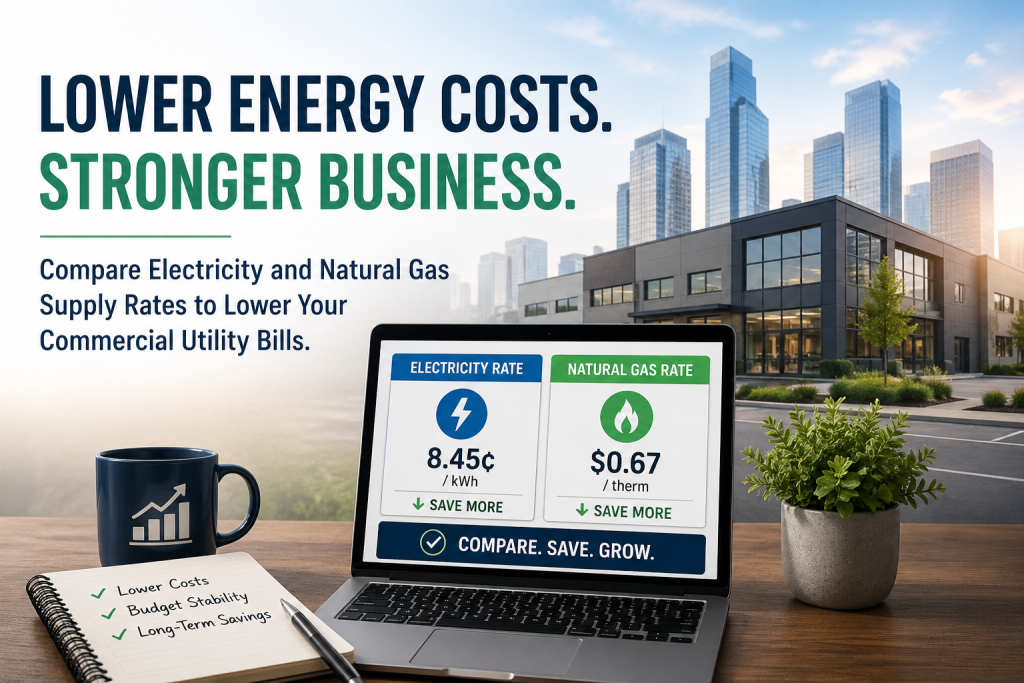
Lower Energy Costs, Stronger Business
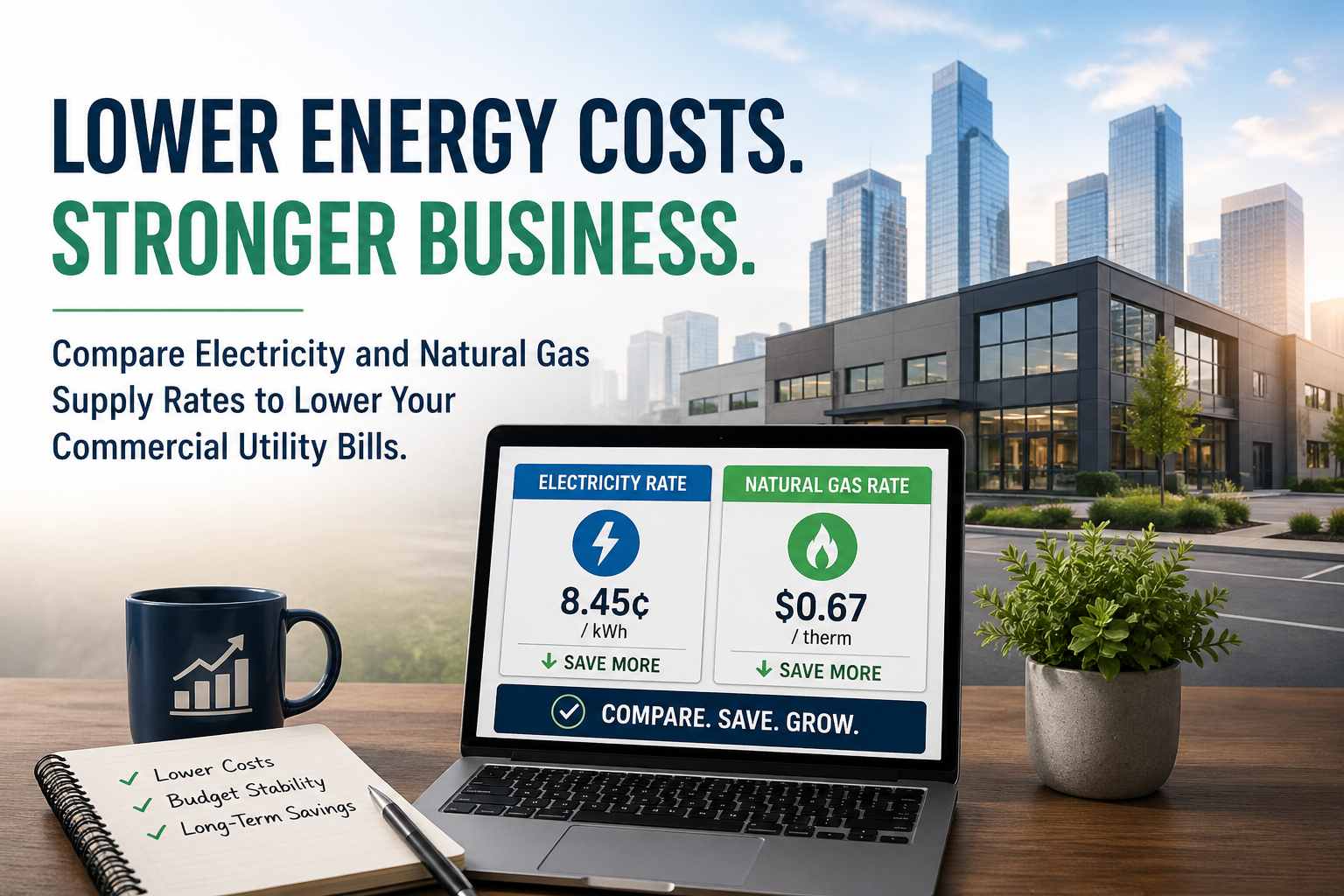
Why Every Business Should Compare Commercial Electricity and Natural Gas Supply Rates
In today’s volatile energy market, one of the most overlooked opportunities for cost savings sits right inside your monthly utility bill. Whether you operate a small retail shop, a manufacturing facility, or a multi-location enterprise, your electricity and natural gas supply rates can significantly impact your bottom line. Yet many businesses remain on default utility pricing often paying more than necessary.
Understanding Commercial Energy Supply
Commercial energy bills typically have two main components:
- Delivery (Utility Charges) – Regulated costs for maintaining infrastructure and delivering energy
- Supply (Energy Charges) – The actual cost of electricity (kWh) or natural gas (therms)
In deregulated markets, businesses have the ability to choose their energy supplier for the supply portion. This is where the opportunity lies.
Instead of accepting the utility’s default rate which can fluctuate monthly and trend higher over time businesses can lock in competitive pricing through third-party suppliers.
Why Comparing Energy Suppliers Matters
1. Lower Your Operating Costs Immediately
Energy is a fixed expense for most businesses—but what you pay doesn’t have to be. By comparing multiple suppliers, businesses often uncover lower fixed-rate options that can reduce costs by 10%–30% or more, depending on usage and timing.
2. Protect Against Market Volatility
Energy markets are influenced by factors like weather, natural gas prices, grid demand, and geopolitical events. Default utility rates (often called “variable rates”) can spike unexpectedly.
Locking in a fixed rate provides:
- Budget certainty
- Protection from seasonal spikes
- Long-term cost stability
3. Access to a Competitive Supplier Network
Unlike a single utility option, energy brokers and platforms can access pricing from dozens of suppliers competing for your business. This creates a bidding environment where suppliers sharpen pricing to win contracts.
More competition = better pricing for you.
4. Customized Pricing for Larger Users
Businesses using over 1,000,000 kWh annually (or high natural gas volumes) often qualify for custom pricing. Suppliers analyze load factor, usage patterns, and risk profile to offer tailored rates not available publicly.
This is where the biggest savings opportunities exist.
5. Avoid Costly Contract Pitfalls
Many businesses unknowingly remain on:
- Expired supplier contracts that rolled into higher variable rates
- Auto-renewed agreements without review
- Utility default service after a contract ends
By actively comparing rates before expiration, businesses stay in control and avoid unnecessary cost increases.
Electricity vs. Natural Gas: Both Matter
While electricity tends to get the most attention, natural gas markets can be even more volatile. Seasonal demand especially in winter can cause dramatic price swings.
For example:
- A business paying $0.78/therm one month could see rates jump to $1.50+/therm the next
- Without a fixed contract, these spikes directly impact operating expenses
Comparing both electricity and gas ensures full energy cost optimization.
When Should You Compare Rates?
Timing is critical in energy procurement. Businesses should review rates:
- 90–180 days before contract expiration
- During favorable market conditions (low wholesale pricing)
- After receiving unusually high utility bills
- When expanding operations or opening new locations
Energy pricing is dynamic—waiting too long can mean missing the best opportunities.
The Process is Simpler Than You Think
To compare rates, most suppliers or brokers will request:
- A recent utility bill (electric and/or gas)
- Basic account details (rate class, usage, meter info)
- Authorization (in some cases) to retrieve usage data
From there, multiple suppliers provide competing quotes, allowing you to evaluate:
- Fixed vs. variable rates
- Contract terms (12, 24, 36 months)
- Pricing structure (energy-only vs. all-in)
The Bottom Line
Every business should treat energy procurement like any other major expense something to be actively managed, reviewed, and optimized.
Failing to compare electricity and natural gas supply rates can result in:
- Overpaying month after month
- Exposure to unpredictable price spikes
- Missed opportunities for long-term savings
On the other hand, a simple comparison can unlock immediate savings, improve budget stability, and create a more efficient cost structure.
Take Action
If you haven’t reviewed your energy supply rates recently, now is the time – Click Here to Learn More
A quick comparison using your most recent utility bill could reveal significant savings opportunities with no interruption to your service and no cost to evaluate options.
In a competitive business environment, reducing overhead is critical. Your energy bill is one of the easiest places to start.